Lost Car Title in California? One Form Replaces It
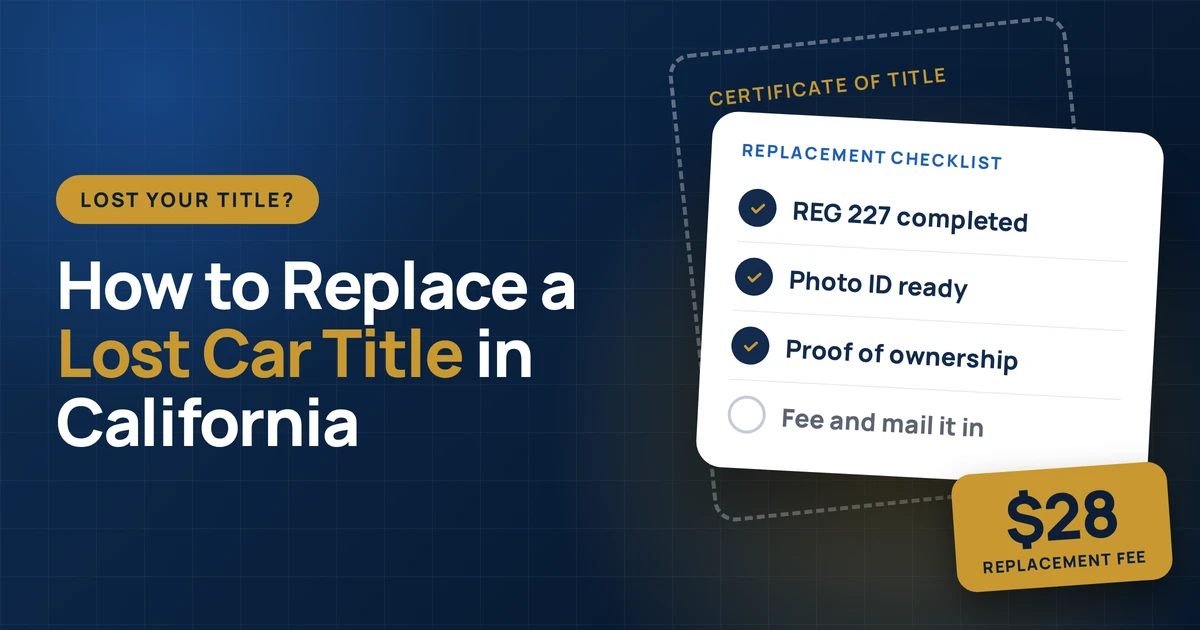
You open the folder where the title should be, and it isn’t there. Maybe a buyer is coming this weekend, or you’re about to move. Either way, DMV has a fix. It replaces lost, stolen, and damaged titles with one form, the Application for Replacement or Transfer of Title, which everyone calls REG 227.
The form is the same in every case. What changes is who signs it, who has to apply, and how long you wait. This page covers each case, so skip ahead to the one that fits you.
The Short Version: What to Do Today
- Look at your registration card. If it names a lender, you still owe money on the car, and the steps change a little.
- Fill out the REG 227 and sign it yourself.
- Add the $28 fee, then mail the form or take it to a DMV field office.
- Wait about 15 to 30 days. DMV mails the new title to you.
If your registration names a lender, read the section on owing money on the car. If you bought the car in another state, read the section on out of state titles.
Who Can Replace a Lost Car Title
If your registration shows no lender, you apply. If it shows a lender, which DMV calls the legal owner, the age of the car decides who applies.
- Two model years old or newer. The lender has to ask for the new title. DMV won’t take a lien release from you for these cars, and that includes the REG 166.
- Three model years old or older. You apply, and the lender signs off on the REG 227 or gives you a notarized lien release.
DMV goes by the model year of the car, so check the year on your registration card. A friend, a family member, or a registration service can send in the form for you. The owner still has to sign it.
How to Get a Duplicate Title in California: What to Gather
Pull these together before you sit down with the form.
- The REG 227. Section 1 asks for your name, address, and driver license or ID number. Section 3 is the missing title statement.
- Your signature. The registered owner signs.
- Photo ID, if you go in person. A California driver license or ID card works. If you live outside California, bring your out of state license plus a second photo ID, such as a passport.
- Proof that you own the car. Your registration card or a renewal notice works. A copy is fine if it matches DMV’s records.
- The $28 fee.
- What’s left of the title, if it’s damaged. Torn, burned, or hard to read? Send the pieces.
You don’t need the old title. That’s the whole point of the form. If you’d like the PDF and a closer look at each box, the REG 227 replacement title form page has both. DMV’s current form is the September 2024 version, so skip older copies you find online.
Filling Out the REG 227 Without Mistakes
Three parts of the form need extra care.
- Section 1, your information. Copy your name exactly as it appears on your registration card, then add your current address and license or ID number. If a name or address is off, DMV may send the form to extra review.
- Section 3, the missing title statement. The person who lost the title fills this out. It tells DMV the title is gone and you want a new one. You also check a box for the reason: lost, stolen, torn or hard to read, never received from the seller, or never received from DMV.
- Section 5, the lender release. You only need it when a lender is on your registration. A notary has to witness it.
Print in black ink, or type the form before you print it. Write clearly, because DMV staff have to read every box.
If You Still Owe Money on the Car
A lien is a lender’s claim on your car until you pay off the loan. If you have one, your registration card lists the lender by name. Check for it first, because it decides who applies.
If your car is two model years old or newer, the lender asks DMV for the new title. A lien release from you won’t speed that up. Call the lender, say you have a lost car title, and ask who handles replacements.
If your car is three model years old or older, you apply. The lender signs Section 5 of the REG 227 in front of a notary, or gives you a notarized lien release. Ask early, because lenders move at their own pace.
Did your lender close, merge, or change its name? DMV posts a list of financial institutions on its website. Look up the new name before you send the form.
Mail It or Take It In?
DMV takes the REG 227 at a field office or by mail. Your choice depends on how well your details match what DMV has on file.
- Everything matches. Your name, address, and license number are the same as on your registration? Mail it. You don’t have to go in.
- Something is different. DMV sends a mailed form to its headquarters and asks you to come in with your photo ID and proof of ownership. Skip the detour and go in person.
DMV suggests making an appointment, so you skip the line. If you plan to mail it, you’ll notice the REG 227 doesn’t print a mailing address. DMV’s title page lists DMV, PO Box 942869, Sacramento, CA 94269 for title paperwork. Call 1 800 777 0133 to confirm before you send anything.
Plan on 15 to 30 days for the new title to come by mail. DMV doesn’t promise anything faster, so don’t set a sale date or a moving date around the best case.
What a Replacement Title Costs
DMV lists the replacement title fee at $28. Fees can change, so check DMV’s registration fees page before you send a check. By mail, DMV takes a check or a money order. At a field office, you can also pay by card, and card payments carry a small service fee.
This detail helps: if you apply only for a replacement title, you don’t have to pay your registration renewal or clear parking tickets first.
When Your Address Has Changed
Moved since you last told DMV? That can cause trouble. On a mailed form, DMV compares your address to its records. Say the two don’t match, and DMV also shows it sent you a replacement title in the last 90 days. In that case, DMV asks for a vehicle check on REG 31, done by the California Highway Patrol.
The easy fix is to update your address first with a DMV 14 change of address. Send the REG 227 once your record shows the new address. It adds a few days, but it avoids the extra checks.
Titles From Another State
Look at your registration card. If it says Nontransferable or No California Title Issued, California never gave you a title, so a REG 227 can’t replace one. You need to ask the state that last titled the car. If that state won’t issue one, DMV may ask for more paperwork, and sometimes a motor vehicle bond. Start with your old state’s motor vehicle office, because their timeline sets yours.
Selling a Car When the Title Is Missing
You can’t sell a car without a title. DMV says that when the title is missing, you complete the REG 227 first. So file the replacement before you list the car, or at least before you promise a buyer a date.
If a buyer is already waiting, DMV lets the transfer paperwork go in with the REG 227. That works, but the buyer still needs the new title in the end, and you may wait on a lender or a notary at the same time. File early.
If the Title Was Stolen or Turns Up Later
If you think someone stole the title, check the Stolen box in Section 3. DMV’s form doesn’t ask for a police report, but you can report the theft to your local police if you worry someone could misuse the title.
A new title cancels the old one. If the old title turns up after DMV issues the replacement, don’t use it to sell the car. Keep the new title in a safe place at home, not in the glove box.
Special Cases
- Company cars. An authorized person signs, and DMV checks that person’s ID. If the company address changed, add a letter on company letterhead that lists the old and new addresses and asks for a replacement title.
- Cars in a trust. DMV treats the trustee as the owner. If the record shows no trustee, or a different one, send a Statement of Facts on REG 256 naming the trustee. DMV doesn’t ask for the trust papers.
- Damaged titles. Send every piece, even if fire or water ruined the writing.
- The seller never gave you the title. The form has a box for a title you never received from the prior owner.
- DMV issued a title that never came. The form has a box for that too. DMV asks you to wait 30 days from the issue date first.
Mistakes That Slow Things Down
- Leaving out Section 3, the missing title statement
- Using a name or address that differs from your registration
- Skipping the notary on Section 5 when your registration shows a lender
- Asking a lender to release the lien on a car that is two model years old or newer
- Letting someone else sign the form for you
- Sending a REG 227 for a car whose registration says Nontransferable
- Waiting until you have a buyer before you apply
- Mailing an old fee amount
Frequently Asked Questions
How much does a replacement title cost in California?
DMV lists the replacement title fee at $28. Fees can change, so check DMV’s registration fees page before you pay. You don’t have to pay renewal fees or parking tickets first when you apply only for a replacement title.
How long does it take to get a duplicate title in California?
DMV says titles usually arrive by mail within 15 to 30 days. A name or address that doesn’t match, or a lender who is slow to sign, can add time.
Can I get a duplicate California title online?
DMV’s title page tells owners to send the REG 227 in person or by mail. It doesn’t list an online option for this form.
Does the REG 227 need a notary?
Only when a lender appears on your registration. In that case, a notary has to witness Section 5. If the registration shows no lender, you don’t need a notary.
Can someone else apply for a replacement title for me?
Yes. A family member, a registration service, or another person can send in the form. You still have to sign the REG 227 yourself.
Can I sell my car in California if I lost the title?
Not until you replace it. DMV says a missing title means you complete the REG 227 first. The transfer paperwork can go in with it, but the buyer still needs the new title.
Can I rush a replacement title in California?
DMV’s title page doesn’t list a rush service. Some websites mention one, so call DMV at 1 800 777 0133 before you pay anyone extra to speed it up.
What happens if I find my old title after DMV issues a new one?
The new title cancels the old one, so don’t use the old one to sell the car. Keep the new title in a safe place.
What if my bank still holds the lien on my lost title?
If the car is two model years old or newer, the lender has to ask for the new title. If it’s older, you apply, and the lender signs the REG 227 or gives you a notarized lien release. Call the lender before you file.
What if my registration says Nontransferable or No California Title Issued?
You can’t use the REG 227. Ask the state that last titled the car for a replacement. If that state won’t issue one, DMV may ask for more paperwork and a motor vehicle bond.