Fixing the Car Is the Easy Part
You bought the wreck, replaced the panels, and the engine finally runs. Plates are still a long way off. DMV sees a car that was once reported as a total loss. It will not register that car until someone official checks the rebuild.
That check comes with its own paperwork, an appointment you cannot skip, and a few rules that surprise people who already spent the money. Learn them before you buy the parts, not after.
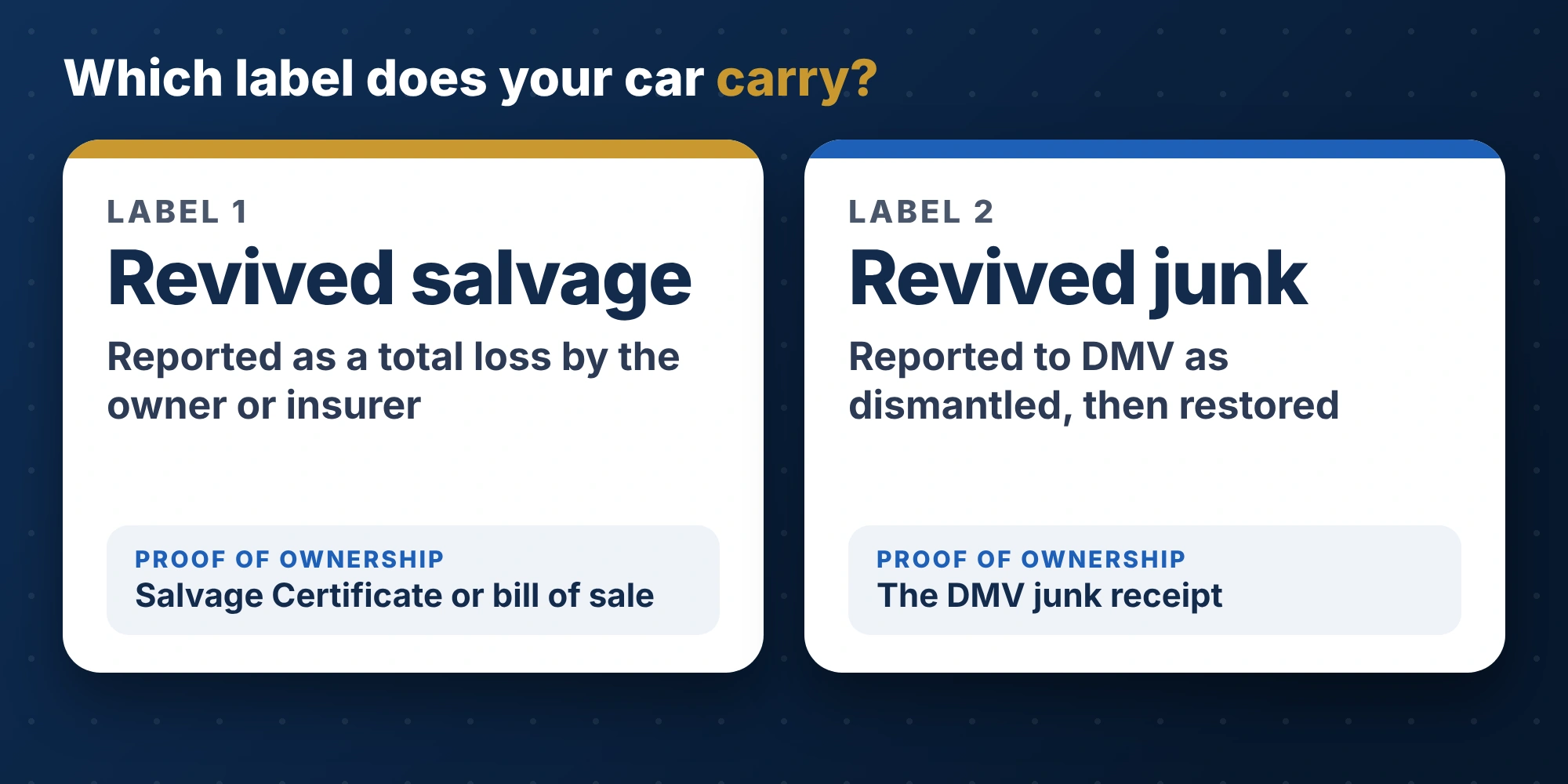
Salvage, Junk, and Nonrepairable: Which Label Does Your Car Carry?
DMV treats these as different cases, and the label decides your paperwork.
- Revived salvage. The owner or the insurance company reported the car to DMV as a total loss, and someone later rebuilt it to run again.
- Revived junk. Someone reported the car to DMV as dismantled, and it was later restored. A dismantler is a business that buys and sells salvaged, junked, and nonrepairable cars.
- Nonrepairable. DMV’s pages on registering a rebuilt car do not cover every case. A car marked nonrepairable has no path described, so call DMV before you spend money on one.
Check the paper that came with the car. If you cannot tell which label applies, ask DMV before you buy parts.
Papers to Collect Before You Book an Inspection
For a revived salvage car, DMV’s list starts with these items:
- The REG 343 form, signed by every current owner
- A Salvage Certificate in your name or signed over to you, or a California title in your name or signed over to you
- Proof of who owned the car before you: a REG 262 transfer form, or a bill of sale when no odometer disclosure is needed
- A completed verification form, or a CHP Certificate of Inspection (CHP 97C)
- An electronic VSSI certificate, which is the brake and light inspection result
- Fees
DMV’s older brochure calls this “brake and light certificates,” while its current page says VSSI. Ask the station for the electronic certificate, and confirm with DMV if your paperwork uses the older name. A trailer of 3,000 pounds or less is exempt.
If you bought the car from a licensed dismantler, DMV asks for a REG 262 that carries the dismantler’s vehicle acquisition number. DMV does not post REG 262 online, so call 1 800 777 0133 to request it.
A revived junk car swaps the ownership proof for the junk receipt DMV issued. If someone else holds that receipt, that person completes a REG 256 statement to explain what happened to it.
Papers you may also need
- REG 488C, the application for a salvage or nonrepairable certificate, when the certificate is missing or not in your name
- REG 256, in the same missing paper cases
- A duplicate title application if you need a title in your name
- A weight certificate from a California public weighmaster, for trucks and pickups
- A GVW declaration for commercial vehicles at 6,001 pounds or more, except pickups
- A smog certificate, unless the car qualifies for an exemption
- REG 4017 for most trailers
Steps to Register a Salvage Vehicle in California
DMV does not number these steps for you, but this order saves trips.
- Sort out ownership first. Make sure the salvage certificate or title is in your name before you spend more on the car. Fixing a missing certificate later holds everything up.
- Repair the car and save every receipt. Keep parts bills of sale and repair invoices in one folder.
- Get the brake and light inspection. Use a California state licensed station.
- Book your inspection. The CHP will not inspect without an appointment. Call 1 800 835 5247. Ask DMV whether a REG 31 applies to your car instead.
- Handle smog. Use a California state licensed smog station, unless your car is exempt.
- Submit the packet and fees. Surrender your old license plates with it.
DMV also warns that it will not issue a California title if you skip a required certification.
What to Bring to the Inspection
Bring proof of ownership, the parts bills of sale, and the repair receipts. These show what the rebuild cost and where the parts came from.
Two rules catch people out. First, DMV counts labor as part of the cost, even labor you did yourself. Write down your hours and a fair rate as you work, because you will want those numbers later. Second, any airbags must work and must meet federal safety standards and the maker’s specifications.
A Salvage Car From Another State
A car that was never registered in California and was reported as salvaged elsewhere can still be registered here. The catch is that California does not recognize an out of state salvage inspection. The car gets inspected again under California’s rules, whatever another state already signed off on.
If you plan to move the car out of California, DMV advises you to register it before it leaves. Ask DMV how that applies to your situation.
Fees and Other Costs
DMV lists many possible charges for these cars. They include registration, CHP, vehicle license, weight, county, and use tax fees. They also include the salvage certificate, duplicate title, transfer, substitute plates, prior history, and a salvage inspection fee. Which ones apply depends on your car.
Plan for two things. The inspection fee is collected when you present your application, and DMV does not refund it. Also, penalties may apply if the registration expired and the car was not on planned nonoperation. Use DMV’s fee calculator for your total. Several sites quote old figures with no source.
Where Applications Get Stuck
- The salvage certificate is missing or not in their name
- They show up for a CHP inspection without an appointment
- They rely on an inspection certificate from another state
- They forget the smog certificate
- They forget to hand in the old plates
Each of these comes straight from DMV’s own requirements, and each costs a return trip.
Last Check Before You Apply
- You know whether the car is revived salvage or revived junk
- The certificate or title is in your name
- REG 343 carries every owner’s signature
- The CHP inspection appointment is booked
- The brake and light certificate is electronic and current
- Parts bills and repair receipts are in one folder
- Smog is done or you confirmed an exemption
- The old plates are ready to hand in
Frequently Asked Questions
Can you register a salvage vehicle in California?
Yes, after it has been rebuilt and passed the required inspections. DMV says it can then issue a branded title and registration. It will not register the car while it is still unrepaired.
What is the difference between revived salvage and revived junk?
A revived salvage car was reported to DMV as a total loss by the owner or insurer. A revived junk car was reported as dismantled. Both can be restored, but they need different proof of ownership.
Do I need a CHP inspection for a rebuilt car?
DMV asks for either a REG 31 or a CHP Certificate of Inspection, called a CHP 97C. If you go through the CHP, you must book an appointment. DMV’s number for that is 1 800 835 5247.
Will the salvage brand ever come off my title?
DMV’s pages say it issues a branded title after the rebuild. They do not describe a way to remove the brand, so plan on it staying. Ask DMV if you hear otherwise.
Does California accept a salvage inspection from another state?
No. DMV says California does not recognize out of state salvage inspection certifications, so the car needs the California inspections.