A Short Inspection That Can Hold Up Your Registration
You filled out the application, and then DMV says the car needs a verification before it will finish the job. That one line sounds small. Yet VIN verification in California is a physical inspection you cannot do yourself, and one mistake on the form can mean paying for it twice.
A verifier looks at the car, compares its identification number with your ownership papers, and signs a form. DMV, a licensed verifier, or a trained officer can do that, and each one has limits.
What VIN Verification Means for Your Car
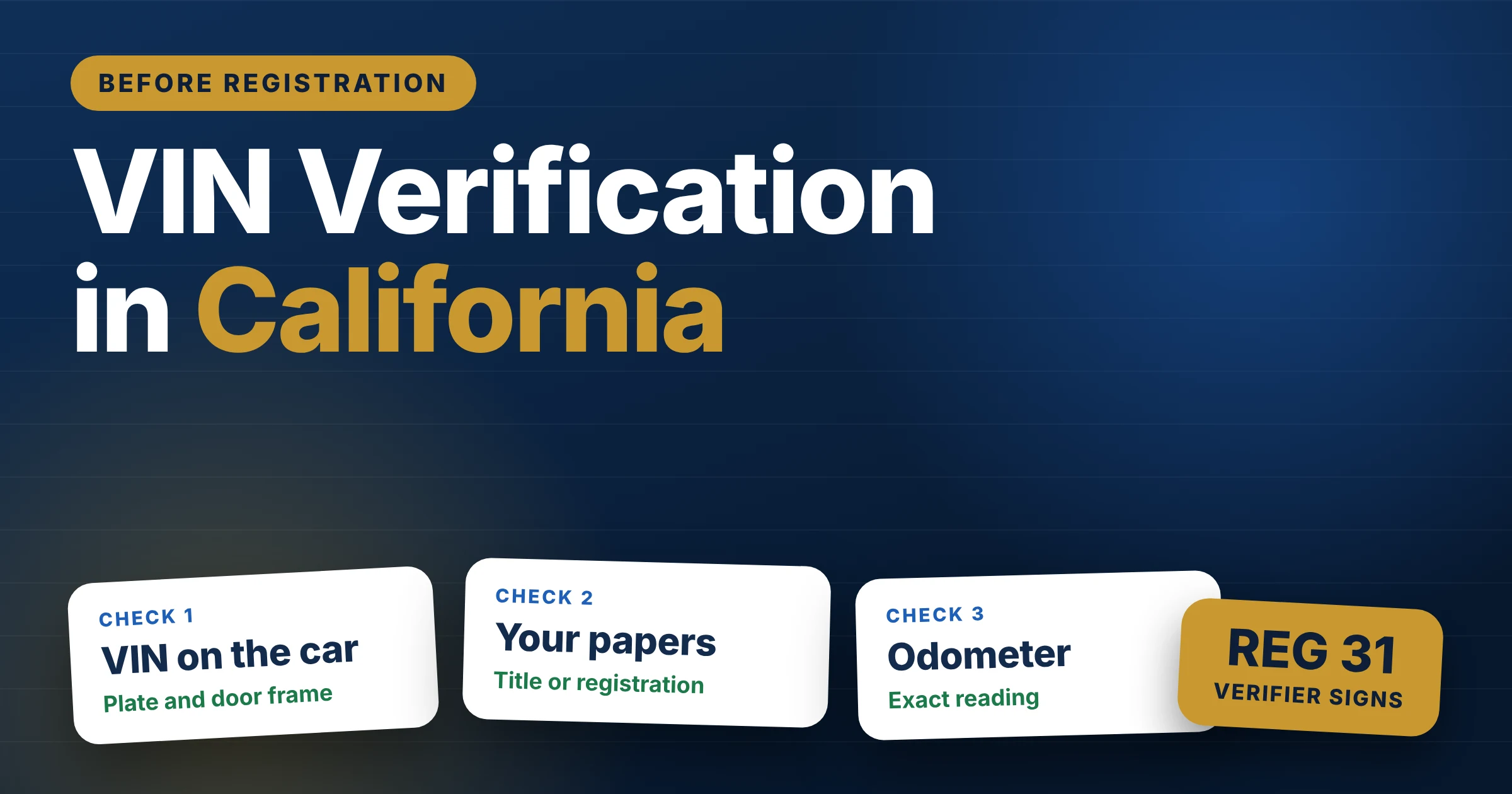
Every car carries a vehicle identification number, or VIN. Verification means an authorized person inspects the whole car and records what they see on a form called the Verification of Vehicle, or REG 31. DMV uses the form to confirm that the car in front of the verifier is the car on your papers.
It is an identity check. DMV’s form has no section for brakes, lights, or engine tests, and it is not a smog check. The verifier reads the marks on your car and writes them down.
When DMV Asks for a Verification
DMV decides case by case. Its manual says DMV may require a physical inspection before it completes a registration application. It names one case that always needs it: a vehicle that does not meet California emission standards.
The other common case is a car from another state. DMV’s page on registering an out of state car lists this form among the items for a nonresident vehicle. You also need your REG 343 application, the last out of state title, and the last out of state registration.
DMV’s pages do not list every other situation in plain words. If you are not sure your car needs one, call DMV at 1 800 777 0133 before you pay anyone.
Who Can Complete a REG 31
You cannot. The form says in capital letters that the applicant does not complete it. These people can:
- A DMV representative
- A California licensed vehicle verifier
- An authorized auto club employee
- A properly trained peace officer
The California Highway Patrol can verify a car too. DMV licenses private verifiers, who must post a surety bond and pass a background check. That is why you should ask any private verifier for a license number before you book.
A licensed verifier cannot take every car. The form sends these cases to DMV or the CHP:
- Cars with a missing or altered federal certification label
- Revived salvage or junk vehicles
- Specially constructed vehicles
- Used motorcycles with no California record
- Vehicles with foreign documents
- Motorcycles with an engine change
What the Verifier Checks on Your Car
The form follows nine numbered sections. In plain words, the inspector, whom DMV calls the verifier, records:
- Where the VIN sits. Common spots are the driver side body, the door frame, the engine compartment, and the plate visible through the windshield.
- How it is attached. Rivets, adhesive, screws, or stamped metal.
- Its condition. Whether it agrees with your papers, looks damaged, or shows signs of tampering.
- The model year. For 1980 and newer cars, the verifier reads it from the 10th digit of the VIN.
- The federal certification label. Cars from model year 1970 on need one, in most cases.
- The odometer. The exact reading, with no tenths.
- Your ownership document. The verifier compares the VIN with your title, certificate of origin, salvage certificate, or registration card.
- The emission label. Required on cars from model year 1968 and newer.
For 1981 and newer cars, DMV expects a 17 digit VIN that passes its check digit test. A car with fewer digits goes to the CHP.
Getting Ready for Your Appointment
The verifier has to inspect the complete, assembled car, so the car must be where the verifier is, or the verifier must come to the car. Ask which one applies before you book.
- Bring your ownership papers, such as the title or the last registration.
- Wipe dirt off the VIN plate at the windshield and the door frame.
- Have the odometer readable.
A few minutes of cleaning helps because the verifier has to read every digit.
What VIN Verification Costs
DMV’s nonresident page lists no separate verification fee. It lists registration, transfer, and use tax fees, and it points you to its fee calculator for an estimate. DMV’s pages also do not set a price for private verifiers. Each one sets its own, and a mobile visit may cost more than a shop visit. Ask for the total, including travel, before you book.
For an out of state car, DMV says registration fees are due within 20 days of the date they become due. DMV tells you to send the application and fees on time even if the title or smog certificate is not ready yet.
When the VIN Does Not Match Your Papers
A mismatch does not always mean fraud. A typing error on a title can cause one. The form has a section for exactly this case, called the Statement of Facts. You sign it under penalty of perjury, and you state that you knew of no difference between the car and your titling documents.
Do not sign that section unless it is true. If the verifier sees signs of tampering or a VIN that was ground off, the verifier must report it to DMV’s Investigations Section right away.
Check the Form Before You Leave
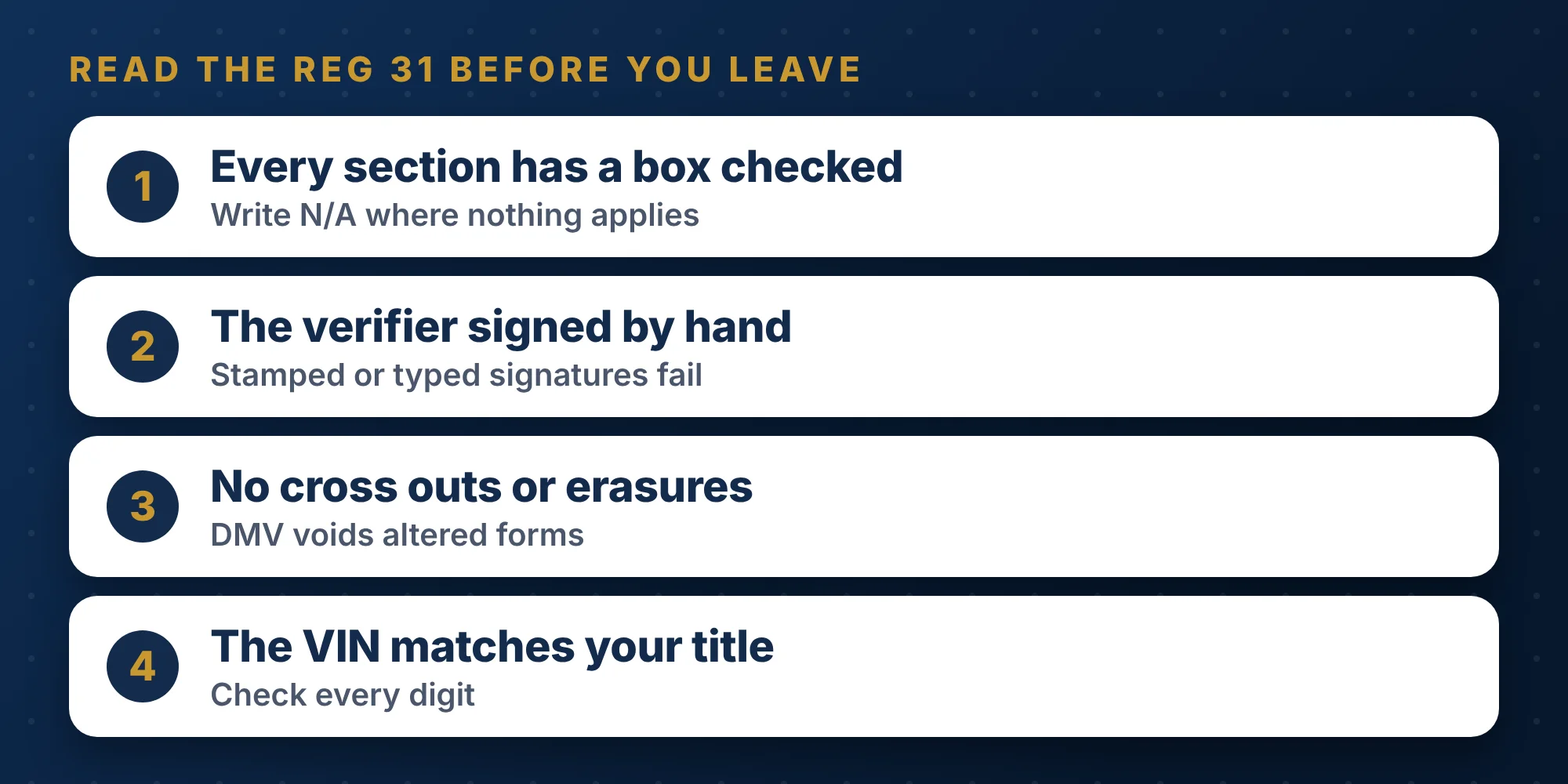
DMV voids a form with missing sections, alterations, cross outs, or erasures, even when someone initials them. You then need a new verification, and a new fee.
- Every numbered section has at least one box checked
- Areas that do not apply say N/A, not blank
- The verifier signed by hand, because a stamped or typed signature does not count
- The place and date of signing appear
- The VIN matches your title, digit for digit
Frequently Asked Questions
Can I verify my own VIN?
No. The form says the applicant does not complete it. A DMV representative, a California licensed verifier, an authorized auto club employee, or a trained peace officer must.
Does every car need a VIN verification?
No. DMV decides case by case. A car that does not meet California emission standards always needs one, and DMV lists the form among the items for an out of state car. Call DMV at 1 800 777 0133 if you are unsure.
Is VIN verification the same as a smog check?
No. Verification identifies the car. It does not test the engine or the exhaust. A smog check is a separate requirement.
Can AAA do a VIN verification?
The form names an authorized auto club employee among the people who may complete it. Ask your club whether it offers the service before you go.
What if my VIN does not match my title?
The verifier records the difference, and you may need to sign the Statement of Facts on the form if the difference is an honest error. Signs of tampering get reported to DMV.