Clearing Customs Is Only Half the Job
Your car got through customs, and now California DMV wants its turn. This is where many imports stall, because DMV asks for proof that customs never handed you.
Before you start to register an imported car in California, find out which of two paths your car is on. That one answer decides your papers, your deadlines, and sometimes whether DMV will register the car at all.
Two Paths: a US Model or a Direct Import
DMV calls a car a direct import when the maker built it for another country and never meant it for sale or use in the US. Think of a Japanese market sports car or a European model with foreign lights and a foreign emissions setup. Direct imports usually do not meet US federal safety rules or California emissions rules.
A car built to US standards but bought abroad is a different case. It usually carries the right labels already, so the paperwork is lighter.
Look at your car for three things:
- A federal certification label, usually on the driver door frame
- A US emissions label in the engine bay
- A California emissions label, if the car was sold new in California
If the car has none of them, treat it as a direct import and plan for the longer route below.
Cars California Will Not Register
Read this part before you pay for shipping. DMV says a vehicle that was not built to meet federal safety standards and California emissions standards cannot be registered here. The one way around that is to modify and test the car under the Air Resources Board (CARB) direct import program.
DMV adds three warnings:
- Motorcycles, off highway vehicles, and diesel vehicles cannot currently be converted to California standards. They qualify only if the maker built them to US and California standards from the start.
- Converting a car that is more than two years old may be expensive or impossible.
- Some imports cannot be registered in California or anywhere in the US.
If you have not bought the car yet, call CARB at 1 800 242 4450 with the make, model year, and VIN. A ten minute call costs less than a car stuck at a port.
Papers to Collect Before You Go to DMV
For a direct import, DMV’s list looks like this:
- Proof of ownership. An out of state title or other proof you own the car.
- Proof of customs clearance. Customs forms stamped and endorsed by CBP. DMV names the HS 7, 3299, 3311, 3461, 6059, and 7501.
- Safety proof, when it applies. A federal certification label on the car, a manufacturer letter, a bond release letter from NHTSA, or a certificate from a CARB licensed laboratory.
- Emissions proof, when it applies. An EPA and California emissions label on the car, a smog certificate, or a laboratory certificate. DMV says you need no smog certificate if you submit the laboratory certificate for original registration.
- A weight certificate for imported trucks and pickups.
- Fees.
DMV words the age limits in two ways. One DMV page calls federal safety evidence mandatory for cars made after 1995. Another asks for it on cars 24 years old or newer. That second page also asks for US emissions proof on cars 20 years old or newer. Do not guess. Give DMV or CARB your model year and ask which rule applies to you.
One more point. A Canadian built car can sometimes use a letter from the maker that confirms US safety and emissions compliance, and DMV says that letter is usually available only for Canadian vehicles. Ask the maker for it before you ship.
The Forms Behind an Imported Car Registration
Every imported car starts with the title and registration application, which is REG 343. After that, DMV lists these forms for direct imports:
- REG 31 vehicle verification, always. A verifier completes it, not you.
- The Statement of Facts form, REG 256, always.
- REG 262, the Vehicle/Vessel Transfer and Reassignment. DMV does not post it online because it prints on security paper. Ask a DMV office for a copy.
- A lien release form, REG 166, only when a lender held a lien.
- A weight declaration, REG 4008, for a commercial vehicle.
Deadlines That Start the Day the Car Arrives
DMV’s clock starts when the car enters California, and it does not wait for your paperwork. Registration fees are due within 20 days of entry, even if you still lack other documents. Pay them on time, then use the one time 30 day temporary operating permit that DMV issues to finish the rest.
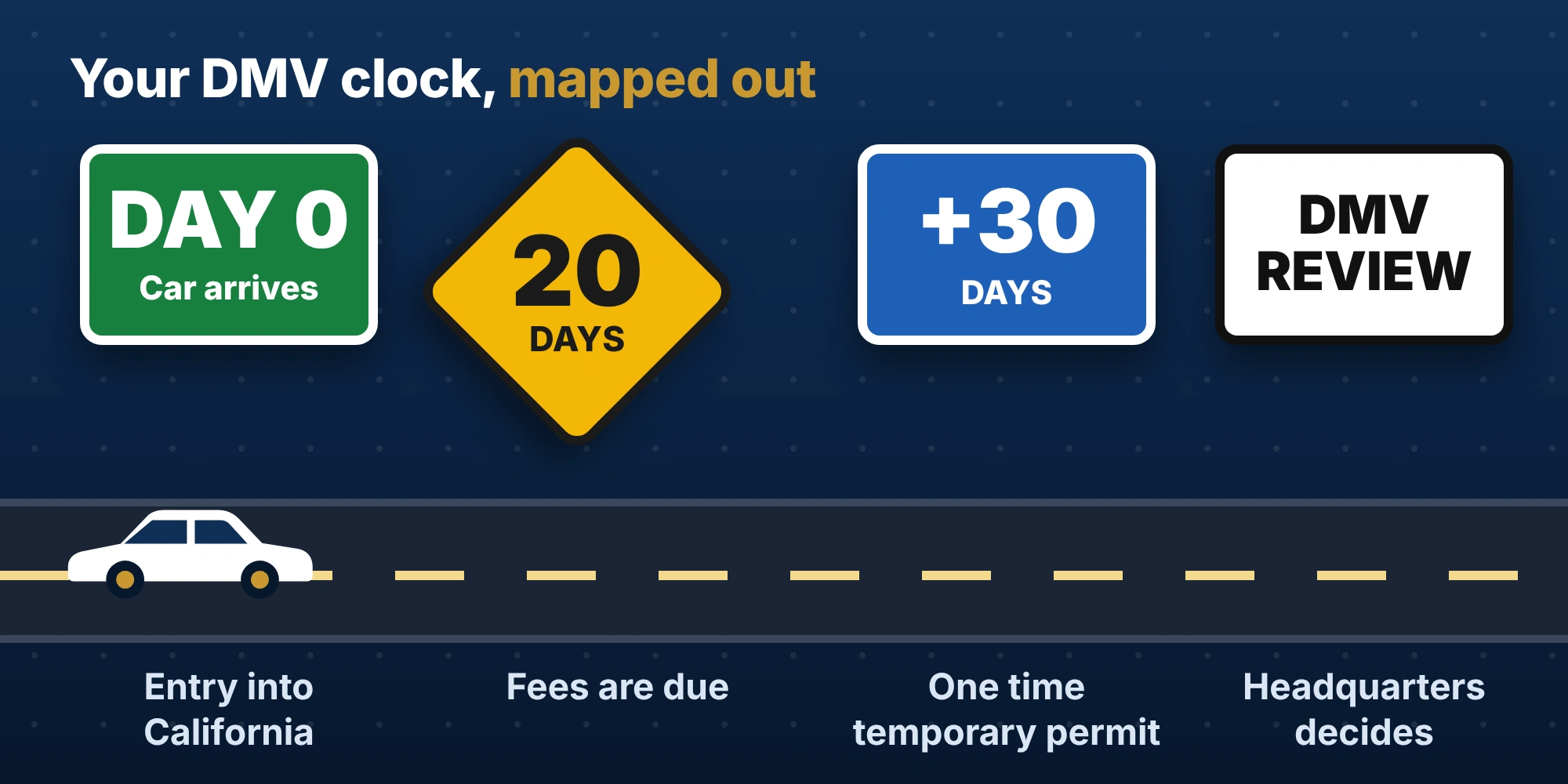
After that, a DMV field office sends your application to the Technical Compliance Section at DMV headquarters. That section decides whether the car can be registered in California. DMV gives no timeline for that review, so do not plan a move or a sale around it.
VIN Verification on an Imported Car
Verification matters more on an import than on a regular used car. The form bars licensed private verifiers from certain cars, and imports often fall in that group. A car with a missing federal certification label, or with foreign documents, goes to DMV or the California Highway Patrol instead. Before you book anyone, check who can complete a verification and what voids the form.
Foreign VINs can also trip you up. DMV expects a 17 digit VIN on 1981 and newer cars, and shorter numbers go to the CHP.
What a NON-USA Title Means
If the car has neither a federal certification label nor a US emissions label from the maker, DMV brands the title NON-USA. The brand goes on the title itself, so any future buyer will see it. Plan for that if you expect to sell the car someday.
Fees and Taxes to Plan For
DMV points to its registration fee calculator for the registration bill. It also points to the IRS for the gas guzzler tax and to the state BOE for use tax. These are not DMV fees, and they can change your total, so ask each agency what applies to your car. We do not list amounts here, because they depend on the car and the date.
Last Check Before You Visit DMV
- You know whether the car is a US model or a direct import
- CARB confirmed the car can be registered, if it is a direct import
- Stamped customs forms are in your folder
- Ownership papers match the VIN on the car
- Safety and emissions proof are ready for your model year
- REG 343, REG 31, REG 256, and REG 262 are in the packet
- The 20 day fee date is on your calendar
Frequently Asked Questions
Can I register a JDM car in California?
Only if the car meets federal safety standards and California emissions standards. A direct import that does not must be modified and tested under CARB’s direct import program first. DMV warns that this may be expensive or impossible for cars over two years old. Call CARB before you buy.
Does the 25 year import rule let me skip California’s emissions rules?
No. The 25 year rule is a federal rule about bringing the car into the country. California has its own emissions requirements, and DMV asks for emissions evidence on gasoline cars made after 1968. Give CARB your model year to see where your car falls.
How long do I have to register an imported car in California?
DMV says fees are due within 20 days of the car entering California. Once you pay them, DMV issues a one time 30 day temporary operating permit so you can finish the other requirements.
What is a NON-USA title?
It is a brand DMV puts on the title when the car has neither a federal certification label nor a US emissions label from the maker. It marks a car that was not built for the US market.
Can a car from Canada skip some of these steps?
It can help. DMV accepts a maker’s letter that confirms US safety and emissions compliance, and says that letter is usually available only for Canadian vehicles. You still need customs proof and the standard forms.